Heart disease remains one of the leading causes of death worldwide. When medications and minimally invasive treatments are no longer sufficient, surgery may be necessary to restore heart function and improve quality of life. Patients often hear terms like “bypass surgery” and “open heart surgery” and assume they mean the same thing. However, while they are closely related, they are not identical.
Understanding the difference between bypass and open heart surgery can help patients make informed decisions about their treatment and reduce anxiety before undergoing a cardiac procedure.
In this comprehensive guide, we will explain what bypass surgery and open heart surgery are, how they differ, when they are recommended, their benefits, risks, and recovery expectations.
Understanding Open Heart Surgery
Open heart surgery is a broad term that refers to any surgical procedure in which the chest is opened to access the heart. The surgeon typically makes an incision through the breastbone (sternum) to reach the heart and perform the necessary treatment.
Many types of cardiac procedures fall under the category of open heart surgery.
Conditions Treated with Open Heart Surgery
Open heart surgery may be performed to treat:
- Coronary artery disease
- Heart valve disorders
- Congenital heart defects
- Aortic aneurysms
- Heart failure
- Irregular heart rhythms
- Heart tumors
- Advanced heart disease requiring transplantation
In many cases, the heart may be temporarily stopped during the procedure, and a heart-lung machine takes over the function of circulating blood and oxygen throughout the body.
What Is Bypass Surgery?
Bypass surgery, also known as Coronary Artery Bypass Grafting (CABG), is a specific type of open heart surgery performed to improve blood flow to the heart muscle.
The procedure is recommended when coronary arteries become narrowed or blocked due to the buildup of fatty deposits known as plaque.
During bypass surgery, the surgeon takes a healthy blood vessel from another part of the body and creates a new route around the blocked artery.
This allows oxygen-rich blood to reach the heart muscle more effectively.
Common Blood Vessels Used for Bypass
- Internal mammary artery (chest)
- Radial artery (arm)
- Saphenous vein (leg)
The number of bypasses performed depends on how many coronary arteries are blocked.
Difference Between Bypass and Open Heart Surgery
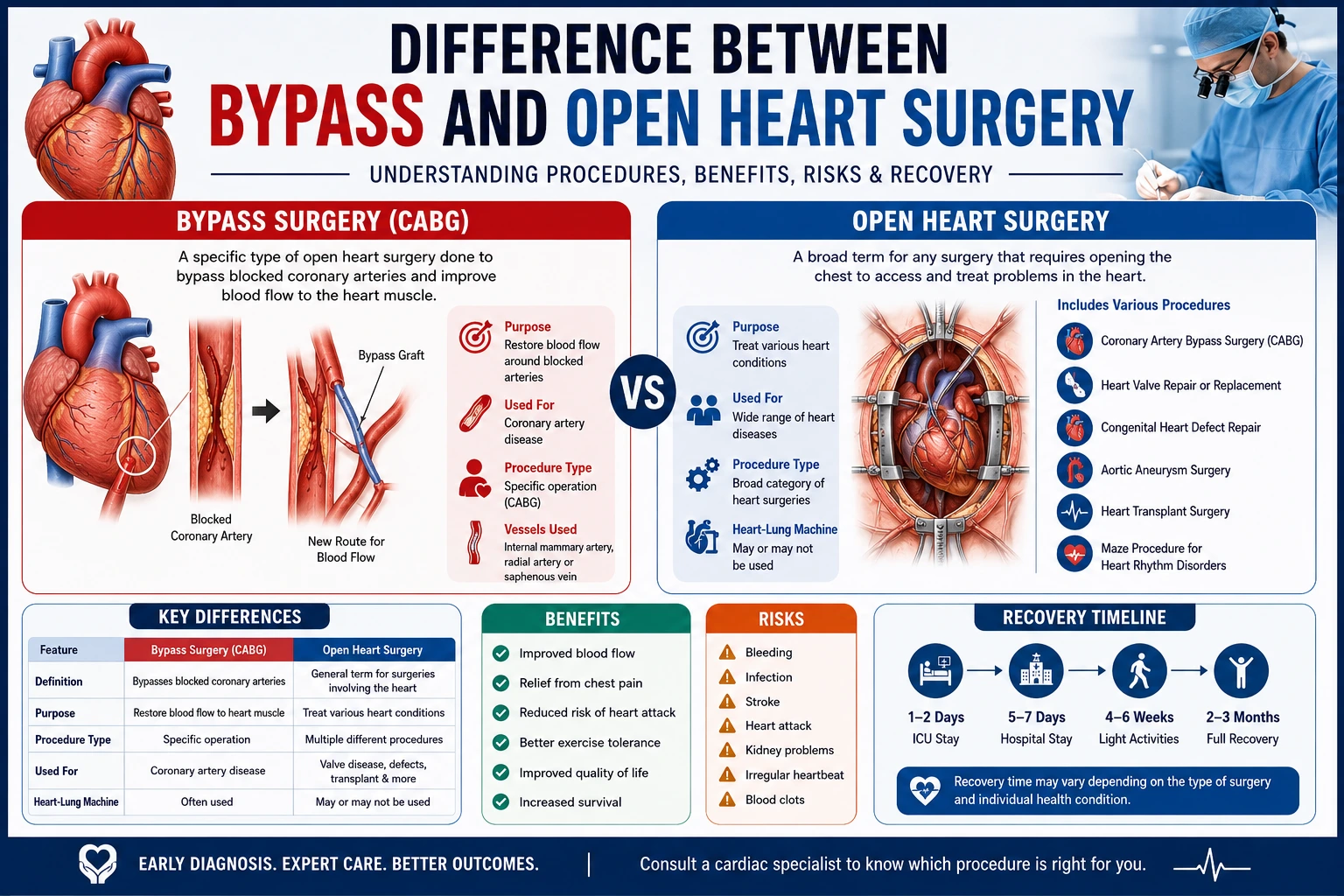
The simplest way to understand the difference is that all bypass surgeries are open heart surgeries, but not all open heart surgeries are bypass surgeries.
Comparison Table
| Feature | Bypass Surgery | Open Heart Surgery |
| Definition | Surgery to bypass blocked coronary arteries | General term for surgeries involving opening the chest to access the heart |
| Purpose | Restore blood flow to the heart muscle | Treat various heart conditions |
| Procedure Type | Specific operation (CABG) | Broad category of heart surgeries |
| Used For | Coronary artery disease | Valve repair, congenital defects, bypass, transplant, and more |
| Heart-Lung Machine | Often used | May or may not be used |
| Number of Procedures | One specific procedure | Multiple different procedures |
This distinction is important because patients undergoing valve replacement or congenital heart defect repair may have open heart surgery without requiring a bypass.
Why Is Bypass Surgery Needed?
The heart muscle relies on coronary arteries for oxygen-rich blood. When these arteries become blocked, blood flow decreases.
This can lead to:
- Chest pain (angina)
- Shortness of breath
- Heart attacks
- Reduced heart function
Bypass surgery creates a new pathway for blood to reach the heart muscle, improving circulation and reducing symptoms.
Situations Where Bypass Surgery May Be Recommended
Doctors may suggest bypass surgery when:
- Multiple coronary arteries are blocked
- Blockages are severe
- Angioplasty or stenting is not suitable
- Previous stents have failed
- Diabetes is present with extensive coronary artery disease
- The left main coronary artery is significantly narrowed
Types of Open Heart Surgery
Open heart surgery includes several different procedures.
Coronary Artery Bypass Surgery (CABG)
Used to bypass blocked coronary arteries.
Heart Valve Repair or Replacement
Performed when heart valves become narrowed or leaky.
Congenital Heart Defect Repair
Corrects structural abnormalities present at birth.
Aortic Surgery
Treats aneurysms or diseases affecting the aorta.
Heart Transplant Surgery
Replaces a severely damaged heart with a donor heart.
Maze Procedure
Used to treat certain heart rhythm disorders such as atrial fibrillation.
As you can see, bypass surgery is only one type of open heart surgery.
How Is Bypass Surgery Performed?
The procedure generally involves the following steps:
Step 1: Anesthesia
The patient is placed under general anesthesia.
Step 2: Opening the Chest
The surgeon makes an incision through the breastbone to access the heart.
Step 3: Harvesting Blood Vessels
Healthy blood vessels are removed from the chest, arm, or leg.
Step 4: Creating the Bypass
The harvested vessel is attached above and below the blocked artery to create a new pathway.
Step 5: Closing the Chest
The breastbone is secured and the incision is closed.
The operation usually takes between 3 and 6 hours depending on the complexity.
How Is Open Heart Surgery Performed?
The exact procedure depends on the underlying heart condition being treated.
However, most open heart surgeries involve:
- General anesthesia
- Opening the chest through the breastbone
- Accessing the heart
- Repairing or replacing damaged structures
- Closing the chest after the procedure
The duration varies significantly depending on the complexity of the surgery.
Benefits of Bypass Surgery
Bypass surgery offers several long-term benefits.
Key Advantages
- Improved blood flow to the heart
- Relief from chest pain
- Reduced risk of heart attack
- Better exercise tolerance
- Improved quality of life
- Increased survival in selected patients
Many patients experience significant symptom improvement after recovery.
Benefits of Open Heart Surgery
The benefits depend on the condition being treated.
Common Benefits
- Correction of structural heart problems
- Improved heart function
- Better blood circulation
- Relief from symptoms
- Prevention of future complications
- Enhanced quality of life
For many patients, surgery can be life-saving.
Risks of Bypass Surgery
Like all major surgeries, bypass surgery carries certain risks.
Potential Complications
- Bleeding
- Infection
- Stroke
- Heart attack
- Kidney problems
- Irregular heartbeat
- Blood clots
The risk level depends on age, overall health, and the severity of heart disease.
Risks of Open Heart Surgery
Open heart surgery shares many of the same risks.
Possible Complications
- Infection
- Excessive bleeding
- Arrhythmias
- Blood clots
- Lung complications
- Stroke
- Organ dysfunction
Modern surgical techniques and careful monitoring have significantly improved safety and outcomes.
Recovery After Bypass Surgery
Most patients remain in the hospital for 5 to 7 days after surgery.
Recovery Timeline
| Recovery Stage | Typical Duration |
| ICU Stay | 1–2 days |
| Hospital Stay | 5–7 days |
| Light Activities | 4–6 weeks |
| Full Recovery | 2–3 months |
Cardiac rehabilitation is often recommended to support recovery and improve long-term heart health.
Recovery After Open Heart Surgery
Recovery varies depending on the specific procedure performed.
Most patients can expect:
- Several days in the hospital
- Gradual increase in physical activity
- Regular follow-up visits
- Recovery period of 6–12 weeks
Patients who undergo complex procedures may require longer recovery periods.
Can Bypass Surgery Be Performed Without Open Heart Surgery?
In some cases, yes.
Advanced surgical techniques allow certain patients to undergo:
- Minimally invasive bypass surgery
- Off-pump bypass surgery
- Robotic-assisted cardiac surgery
These procedures may involve smaller incisions and shorter recovery times.
However, traditional bypass surgery remains the most common approach for many patients.
When Should You Consult a Cardiac Surgeon?
You should seek medical attention if you experience:
- Persistent chest pain
- Shortness of breath
- Fatigue during physical activity
- Heart attack symptoms
- Severe coronary artery disease diagnosis
- Known heart valve disease
Early evaluation allows doctors to determine the most effective treatment option before complications occur.
Why Choose Aayush Hospital for Cardiac Care?
At Aayush Hospital, our experienced cardiac specialists provide comprehensive diagnosis, advanced cardiac surgery, and personalized treatment plans tailored to each patient’s needs.
Our cardiac services include:
- Advanced heart diagnostics
- Coronary artery bypass surgery
- Heart valve repair and replacement
- Minimally invasive cardiac procedures
- Cardiac rehabilitation programs
- Multidisciplinary heart care
We are committed to delivering high-quality cardiac treatment with a focus on patient safety and successful outcomes.
FAQs
Is bypass surgery the same as open heart surgery?
No. Bypass surgery is one type of open heart surgery, but open heart surgery includes many other procedures such as valve replacement and congenital heart defect repair.
Which is more serious: bypass surgery or open heart surgery?
Bypass surgery is a major operation, but the seriousness depends on the specific procedure and the patient’s overall health.
How long does bypass surgery take?
Most bypass surgeries take between 3 and 6 hours.
What is the success rate of bypass surgery?
Bypass surgery has a high success rate and is considered a safe and effective treatment for severe coronary artery disease.
How long does recovery take after open heart surgery?
Most patients recover within 6 to 12 weeks, although complete recovery may vary depending on the procedure and individual health factors.
Conclusion
Understanding the difference between bypass and open heart surgery is essential for patients facing cardiac treatment. Open heart surgery is a broad category of procedures performed by opening the chest to access the heart, while bypass surgery is a specific type of open heart surgery designed to improve blood flow around blocked coronary arteries.
While both procedures can significantly improve heart health and quality of life, the appropriate treatment depends on the individual’s condition, symptoms, and overall cardiovascular health. Consulting an experienced cardiac specialist can help determine the best approach for achieving optimal outcomes.
Contact Details: